
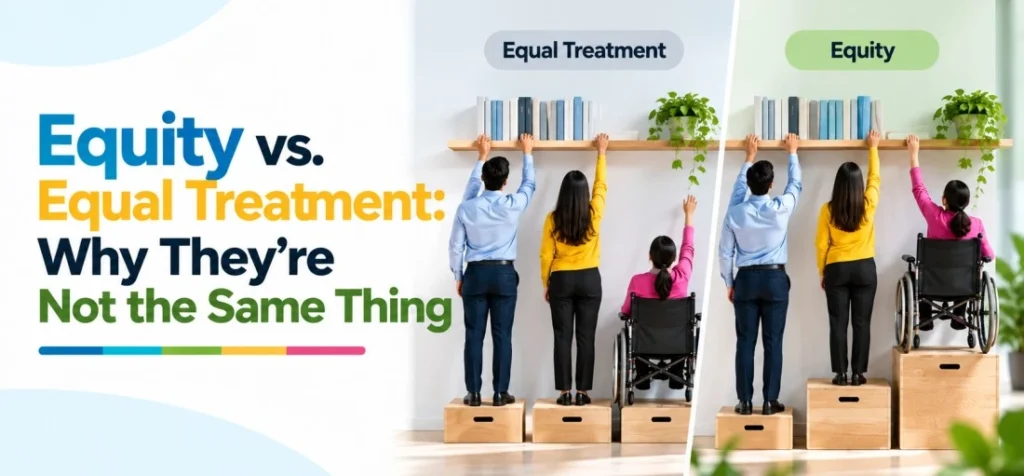
A company gives every employee the same laptop, the same training hours, and the same maternity leave policy. On paper, that looks fair. Everyone gets the exact same thing.
Treating people fairly doesn’t always mean giving everyone identical treatment.
This is the gap most organizations miss when they talk about DEI. They build policies around equal treatment, assuming that treating everyone identically is the same as treating everyone equitably. It isn’t, and the difference shows up in who actually succeeds inside the organization and who quietly struggles.
What Equal Treatment Actually Means
Equal treatment means giving every person the same resources, rules, and opportunities, regardless of their starting point. A new graduate and a working parent get the same onboarding schedule. A person with a disability and a person without one get access to the same office building, with no adjustments made for either.
It sounds reasonable. It’s also incomplete.
Giving everyone the same resources overlooks the different circumstances they may face.
What Equity Actually Means
Equity means giving people what they specifically need to reach the same outcome, not the same starting resources.
A simple way to see the difference: equal treatment gives every employee one chair at a meeting. Equity notices that one employee uses a wheelchair and needs the room arranged differently to participate at all. What mattered was adapting the meeting space so the employee could take part comfortably.
At work, equity shows up as flexible hours for a single parent managing school pickups, a ramp and accessible workstation for an employee with a mobility impairment, or extended deadlines for someone managing a health condition. None of these are special treatment. They’re what it actually takes for that person to perform at the same level as everyone else.
Why This Distinction Matters for DEI
Many DEI programs stall because they’re built entirely around equal treatment. Same training for everyone. Same benefits for everyone. Same promotion criteria for everyone. It feels fair on a policy document, and it’s also the easiest version to implement, which is probably why so many organizations default to it.
But equal policies applied to unequal starting points don’t close gaps. They preserve them.
A woman returning from maternity leave and a colleague who never left don’t start a performance review cycle from the same place. Treating their review identically isn’t fairness; it’s ignoring a real difference that affects the outcome.
What Equity Looks Like in Practice
Equity isn’t about lowering standards or creating shortcuts. It’s about removing the specific barriers that stop someone from meeting the same standard as everyone else.
A few examples of organizations that are using it well:
- Adjusted interview formats for neurodivergent candidates, so the format itself isn’t the barrier to showing their actual ability
- Returnship programs for women re-entering the workforce after a career break, rather than expecting them to compete for the same roles as someone with uninterrupted experience
- Accessible infrastructure and assistive technology for employees with disabilities, built in from the start rather than requested after the fact
- Mentorship specifically for underrepresented groups, where the barrier isn’t skill but access to the right relationships and visibility
None of these give anyone an advantage over their colleagues. They remove a disadvantage that was already there.
Moving From Equal Treatment to Equity
The shift starts with a different question. Instead of asking “are we treating everyone the same,” organizations need to ask “does everyone actually have what they need to succeed here.”
That means auditing policies not just for whether they apply uniformly, but for whether they produce uniform outcomes. It means talking to employees about what’s actually getting in their way, rather than assuming a one-size policy covers it.
Equal treatment is easy to measure. Equity requires paying attention.