
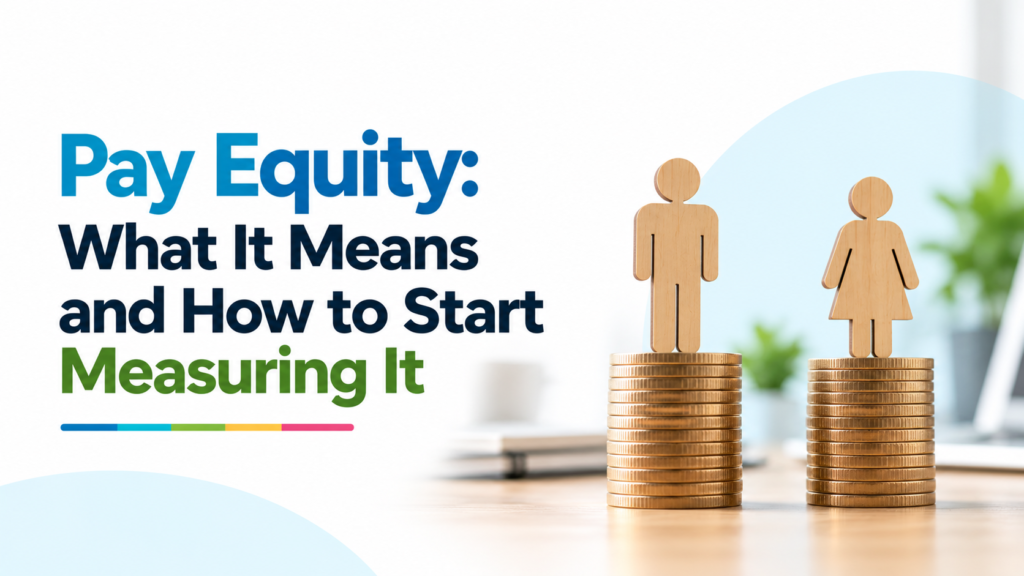
Two employees sit two desks apart. Same title, same team, same manager, same five years of experience. One partner earns 12% more than the other.
Nobody in HR decided that on purpose. It happened through a dozen small decisions over five years, a slightly better negotiation here, a different starting offer there, a raise cycle where one of them asked and the other didn’t. None of it looks like discrimination from the inside. All of it adds up to a pay gap by the time anyone actually checks.
That’s what pay equity work is built to catch.
What Pay Equity Actually Means
Pay equity means employees doing comparable work, with comparable experience and performance, are paid comparably, regardless of gender, caste, disability, or other factors unrelated to the job itself.
It’s often confused with equal pay, but the two aren’t quite the same thing. Equal pay usually refers to paying the same salary for the exact same role. Pay equity is broader. It accounts for the fact that two people in different but comparably valued roles, say, an operations manager and a marketing manager at the same level, should also see fair, comparable compensation relative to their contribution.
Why the Gap Exists Even Without Anyone Intending It
Pay gaps rarely come from one deliberate decision. They build up from small, disconnected ones.
Starting salaries often get set during negotiation, and research consistently shows that men negotiate starting offers more often and more aggressively than women do, not because women are less capable negotiators, but because of long-standing social conditioning around how women are perceived when they push back on an offer. That single starting gap then compounds through every annual raise that follows, since most raises are calculated as a percentage of current salary.
Career breaks for caregiving, which still fall disproportionately on women, often get treated as a gap in experience rather than a pause in it, affecting how a returning employee gets leveled and paid. And in many organizations, pay bands are wide enough, and not transparent enough, that two people in the same role can land at very different points in that band with nobody noticing until someone finally runs the numbers.
How to Actually Measure Pay Equity
Start with a full pay audit, not a sample. Pull compensation data across the entire organization, broken down by role, level, tenure, and performance rating. A partial audit of just one department tends to miss the pattern, since gaps often show up differently across teams.
Group employees by comparable work, not just identical titles. Two people with different job titles can still be doing work of comparable scope and value. The audit needs to account for that, not just compare identical designations against each other.
Control for legitimate factors first. Experience, performance ratings, and tenure are legitimate reasons for pay differences. The goal of the audit is to see what’s left over once those factors are accounted for, the part of the gap that legitimate factors don’t explain.
Look at both the gap and where it concentrates. A company-wide average gap of five percent can hide a thirty percent gap at the senior leadership level and almost nothing at entry level. The average alone won’t tell you where to act.
Repeat it annually, not once. A single pay audit is a snapshot. Gaps tend to creep back in through new hiring and annual raises if nobody’s checking for it the following year.
What to Do Once You Find a Gap
Finding the number is the easier half. What an organization does next is where pay equity work actually matters.
That usually means correcting unexplained gaps directly, through targeted raises for employees found to be underpaid relative to peers doing comparable work, rather than waiting for the next scheduled raise cycle to quietly even things out. It also means tightening how starting salaries get set, so a new hire’s offer depends less on how hard they pushed in negotiation and more on a consistent band for the role. And it means building pay transparency into the system itself, publishing pay bands for each level so employees aren’t negotiating blind against a number they can’t see.
Why This Is Worth the Effort
A pay equity audit can be uncomfortable. It often surfaces gaps nobody intended and nobody wants to explain. But organizations that run this process regularly tend to see less attrition among employees who’d otherwise quietly leave for fairer pay elsewhere, and they build a reputation that makes recruiting easier in a market where candidates increasingly ask about pay transparency before they ask about anything else.
The gap at those two desks didn’t appear because anyone decided it should. It appeared because nobody checked. That’s the part a pay equity audit actually fixes.