
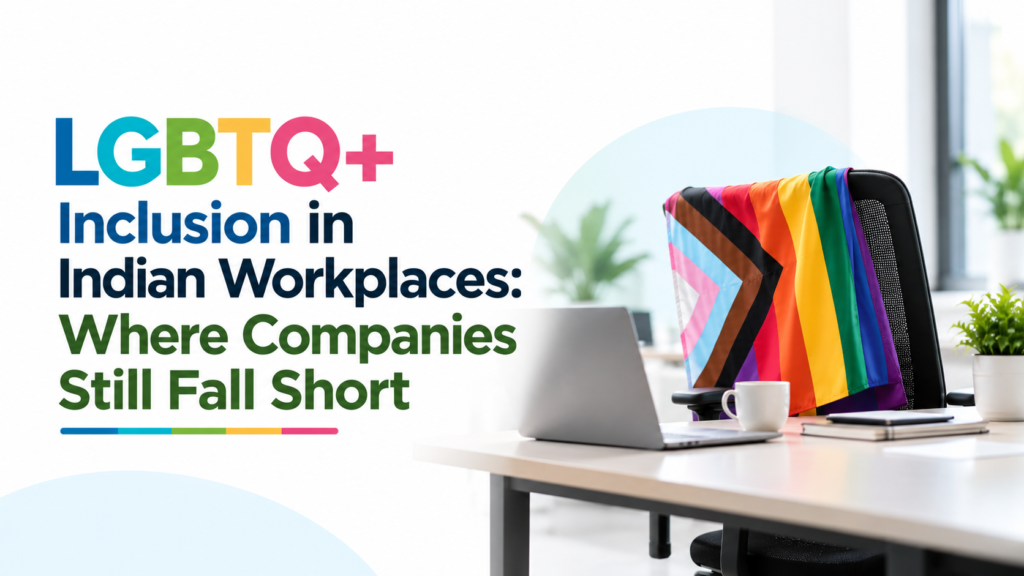
Every June, many Indian companies change their logo to rainbow colors for a few weeks. Fewer of them have a policy for updating an employee’s name and pronouns in the HR system after a gender transition.
That gap says a lot about where LGBTQ+ inclusion actually stands in Indian workplaces right now. The visibility has improved. The infrastructure underneath it mostly hasn’t.
The Legal Picture Has Moved Faster Than Workplace Culture
Section 377 was struck down in 2018. The transgender community gained legal recognition and protection under the Transgender Persons (Protection of Rights) Act in 2019. On paper, the legal groundwork for workplace inclusion exists.
But law-changing and culture-changing are two different timelines. Plenty of employees still don’t feel safe being open about their identity at work, not because any law stops them, but because nothing in their actual workplace tells them it’s safe to.
Where Companies Still Fall Short
Policies that mention LGBTQ+ employees exist, but go no further than a sentence. Many diversity policy documents include a line about “sexual orientation and gender identity” in a non-discrimination clause, and stop there. No guidance for managers. No process for a name change. No clarity on health insurance coverage for same-sex partners or gender-affirming care.
Restrooms and forms still assume a gender binary. Something as basic as a washroom or an HR form that only offers “Male” and “Female” sends a clear signal to transgender and non-binary employees about whether they were actually considered when the system was built.
Benefits rarely extend to same-sex partners. Health insurance, bereavement leave, and relocation support are frequently written around a legally married, opposite-sex spouse. An employee in a long-term same-sex relationship often finds none of it applies to them, even informally.
Coming out at work still carries real risk. Employees worry about being passed over for a promotion, being excluded from client-facing roles, or becoming the subject of office gossip. These fears don’t need to be proven true to shape behavior. Many employees simply stay quiet, which means managers often have no idea who on their team is actually affected by a gap in policy.
Pride month activity without follow-through. A rainbow logo and an internal email in June, with no hiring outreach to the transgender community, no employee and leadership training, and no policy change the other eleven months of the year, reads as performance rather than commitment, and most employees can tell the difference.
What Real Inclusion Looks Like
Clear, specific policy, not a single line. This means an actual process for updating records after a legal name or gender change, clarity on which restrooms and facilities employees can use, and explicit anti-harassment protection that name sexual orientation and gender identity directly.
Benefits available to partners, irrespective of marital status. Health insurance and leave policies that cover a same-sex partner the same way they’d cover a spouse, instead of requiring a marriage certificate that may not legally exist for that employee.
Manager training that goes beyond a compliance slide. Managers are often the first person an employee comes out to at work. How that conversation goes shapes whether that employee stays quiet about everything else too.
Hiring that actually reaches the community. Partnering with LGBTQ+ job boards and community organizations, rather than assuming inclusive hiring happens on its own once a policy exists.
Consistency past the month of June. Support that shows up in hiring, benefits, and daily culture all year, not just in a social media post timed to Pride.
Why This Still Gets Overlooked
A lot of DEI effort in Indian workplaces has focused on gender representation and disability access, both important, both still incomplete themselves. LGBTQ+ inclusion often gets treated as a smaller, separate initiative, if it gets addressed at all, partly because fewer employees are openly out, which makes the need look smaller than it actually is.
That’s exactly the problem. Low visibility isn’t the same as low need. It’s often a sign that the workplace hasn’t given anyone a reason to feel safe being visible.
Moving Past the Rainbow Logo
Real LGBTQ+ inclusion isn’t measured by a campaign. It’s measured by whether an employee can update their name in the system without a fight, whether their partner is covered under insurance, and whether their manager knows how to handle a disclosure without making it a bigger deal than it needs to be.
The logo change takes an afternoon. Building the culture behind it takes actual work, and that’s exactly where most Indian workplaces still have the most distance left to cover.